
Growth does not ask for permission.
It announces itself through resistance.
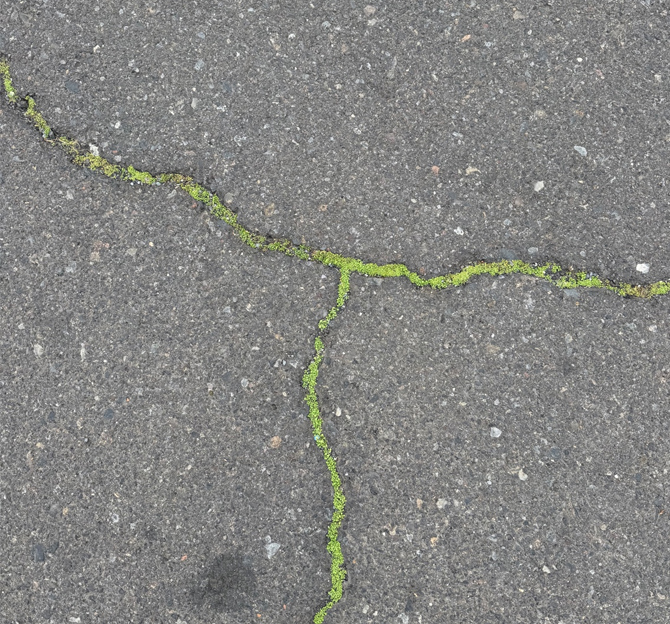
At first glance, the image seems ordinary:
a thin line of green grass pushing its way through a minute crack in solid concrete.
Concrete is designed to suppress life. It is dense, cold, and unyielding. And yet, life does not wait for softness. It searches, persists, and finds expression wherever a possibility e
Life does not grow because conditions are favourable.
It grows because growth is its nature.
That fragile green line is not just grass. It is a reminder that pain, resistance, and constraint are not enemies of growth — they are often the very pathways through which growth happens.
Human life follows the same principle.
We often wish for growth without discomfort, progress without struggle, and maturity without pain. But nature offers no such shortcuts. Every meaningful transformation demands passage through some form of resistance.
Pain is not a sign that something is wrong.
Often, it is a sign that something important is happening.
Consider the pupa transforming into a butterfly. Inside the cocoon, the caterpillar does not simply rest. It dissolves. Its previous form breaks down entirely before it reorganizes into something new expression of life. If the struggle is interrupted, the butterfly emerges weak, unable to fly.
The pain is not incidental.
It is structural.
Perhaps the most profound example of purposeful pain is childbirth.
After nine months of nurturing, protection, and waiting, life does not enter the world gently. It arrives through intense physical pain. Yet, that pain is not pathology — it is process. Without it, birth does not complete. Life cannot cross over from potential into reality.
Creation always demands a final act of courage.
This truth holds across nature — plant, animal, and human. New life, new form, and new identity all emerge through a threshold of discomfort.
One of the most misunderstood forms of pain is the pain involved in raising children well.
To guide children responsibly is to accept discomfort:
- saying “no” when indulgence would be easier,
- holding boundaries when emotions run high,
- remaining firm when love would prefer softness.
Children may resist these moments while growing up. But years later, these are precisely the moments they remember with respect.
What once felt restrictive is later recognized as care.
And when love returns from a grown child — aware, grounded, grateful — it carries a depth that only shared struggle can create. That love is not fragile. It is earned. It is blissful.
Pain endured consciously becomes love received fully.
Pain also shapes us in quieter ways.
Discipline hurts before it strengthens.
Learning feels uncomfortable before it becomes confidence.
Truth unsettles before it liberates.
Athletes endure physical pain to build endurance. Musicians strain through endless practice before achieving mastery. Professionals grow through feedback that challenges ego and comfort.
Every refinement requires friction.
Without friction, there is no polish. Without resistance, there is no strength.
Even in relationships, growth often arrives through difficult con
Pain is often treated as something to escape from immediately. But pain is rarely meaningless.
Sometimes pain signals healing.
Sometimes it warns of imbalance.
Sometimes it invites change.
Sometimes it announces growth.
In every case, pain carries information.
Pain asks not to be feared, but to be understood.
The grass growing through concrete does not experience pain as despair. It experiences resistance as direction. It does not retreat. It grows through.
Human beings possess far greater capacity — awareness, reflection, choice, and meaning.
When pain enters our lives — in parenting, work, relationships, or self-growth — it helps to pause and ask:
What is this pain shaping me into?
Because more often than not, pain is not breaking us.
It is reshaping us.
Pain does not destroy who we are.
It reveals who we are becoming.
Like the grass that finds life in stone, we are not meant to wait for ideal conditions. We are meant to grow through what resists us — and emerge stronger, wiser, and more complete on the other side.
- Arun Sehgal
Copyright © 2024 The Winning Edge Mumbai, India. All Rights Reserved.